14 May 2026
Types of Norwegian Companies
The main types of companies in Norway, from sole proprietorships and partnerships to AS and ASA. Contact our consultants for help choosing and registering.

The first question an entrepreneur must answer is what type of company he can and wishes to register. Depending on the size of the entity, organization form, and the minimum share capital, Norway recognizes two main forms of business: companies (with private or public limited liability) or partnerships (general or limited).
Foreign businessmen may also set up sole traders, which represent the simplest way to start a business in this country (available only for natural persons); foreign companies can expand their business activities in this country through branch offices or subsidiaries. Our team of consultants in company registration in Norway can offer information on the characteristics of each type of business form and may assist in choosing the most appropriate way to start a business here.
What are sole proprietorships in Norway?
The sole trader (or sole proprietorship) is the most basic type of business form that can be registered under the commercial legislation in Norway. The entrepreneur is liable for the gains and losses. It may not be registered at the Central Coordinating Register for Legal Entities, (registration in the Register of Business Enterprises is now voluntary for most sole traders; the former duty for traders reselling goods or with more than five employees was abolished), but it is advised to do that (a registration fee applies), in order to receive an organization number.
| Quick Facts | |
|---|---|
| Types of companies | – Private limited company (Aksjeselskap); – Public limited liability company (Allmennaksjeselskap); – Sole proprietorships Enkeltpersonforetak; – General partnership (Ansvarlig selskap); – Limited partnership (Kommandittselskap); – Partnership with shared liability (Delt ansvar), etc. |
Private limited company | A private limited company in Norway is recognized as a distinct legal entity, thereby limiting your liability as an owner to the extent of the share capital you’ve invested in the company. |
Public limited liability company | The public limited liability company in Norway, known as ASA, is a favored option among foreign investors due to its straightforward registration process and favorable liability responsibilities, making it suitable for establishing large enterprises with multiple shareholders. |
| Sole proprietorships | Registering a sole proprietorship involves selecting a business name and outlining the intended business activities. Entrepreneurs, business owners, freelancers, residents, and non-residents alike can establish a self-employed business in Norway by adhering to a straightforward set of guidelines. |
| General partnership | In a general partnership, two or more owners (partners) share unlimited personal liability for the business, either collectively or individually. |
| Limited liability partnership | This business structure limits partners’ liability to their contributions to the partnership, safeguarding their personal assets from the partnership’s debts and liabilities beyond their invested capital. |
| Share capital | Determine the share capital required for the chosen company structure. For instance for a private limited liability company NOK 30,000 (approx. EUR 2,800) as share capital is required. |
| Registration fee | Pay the registration fee, which varies depending on the company structure and other factors. While registering a branch office, you are required to pay a fee of NOK 3,883 (approx. EUR 365, 2026 digital filing). |
| Organization number | Upon registration approval, the company will receive an organization number from the Central Coordinating Register for Legal Entities (Enhetsregisteret). |
| VAT registration | If applicable, apply for VAT registration with the Norwegian Tax Administration (Skatteetaten). The VAT registration threshold is NOK 50,000 (approx. EUR 4,700) of taxable sales within 12 months. |
| Norwegian Labour Inspection Authority | Registration with the Norwegian Labour Inspection Authority (Arbeidstilsynet) is needed only in certain sectors (e.g. staffing agencies, cleaning, car care); employees are reported through the monthly a-melding. |
| Bank account | Open a business bank account with a Norwegian bank for handling financial transactions. |
| Register employees with NAV | If hiring employees, register them with the Norwegian Labour and Welfare Administration (NAV). |
| Employer’s insurance | Calculate and pay employer’s national insurance contributions (arbeidsgiveravgift, 0–14.1% depending on the zone), reported to the Norwegian Tax Administration (Skatteetaten) through the a-melding. |
| Seek professional advice | Consider seeking advice from legal, financial, and business professionals to ensure compliance and success. Contact our company formation agents in Norway if you are interested in setting up a company. |
Many suppliers ask for this organization’s number. A sole proprietorship may be changed into a limited liability company if the required criteria are met. Our experts in company registration in Norway can help you change your business structure, if the initial business form selected for starting a company here no longer serves its purpose.
How can one register a Norwegian sole trader?
One of the main criteria for starting a sole trader in Norway is the minimum age requirement. The minimum age a person can have when starting a sole trader is 18 years, but it is important to know that Norway allows the registration of this type of entity for even younger persons, of 15 years old, in the situation in which the person’s legal guardian has provided consent in this sense. At the same, a 15 years old person may start a sole trader if the County’s Governor provided approval.
Foreigners are also allowed to open a sole trader in Norway, as there are no residency requirements, but it is necessary to have a business address that is registered in this country. Our team of specialists in company registration in Norway can offer in-depth information on the documents that have to be subscribed to when starting a local sole trader.
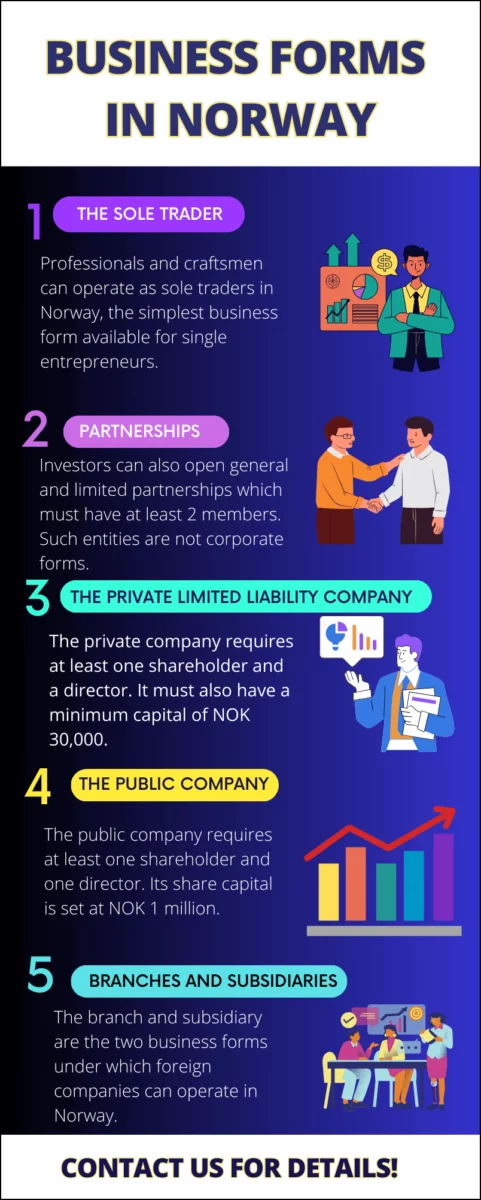
We invite you to discover the main types of companies in our infographic:
What are private limited liability companies in Norway?
A private limited liability company in Norway, known as Aksjeselskap, is based on a share capital of at least NOK 30,000 (approx. EUR 2,800). Its shareholders are liable for the losses and gains but only in the limit of their contributions. The shares of a private limited liability company in Norway are transferable, but unless the articles provide otherwise a transfer requires the company’s consent and the other shareholders have a pre-emption right. It is the most common form a Norwegian small or medium business can take.
What are the taxes for Norwegian private limited liability companies?
When setting up a company in Norway that operates as a limited liability company, the investors should be aware of the taxation system that is applicable in this case. Our team of consultants in company formation in Norway can assist with extensive advice on all the taxes that are due under this business form, but it is important to know that the following will apply:
- the tax on the profits of the company is imposed at a rate of 22%, which needs to be paid in two instalments (15 February and 15 April) in the year following the income year;
- dividends paid to the company’s shareholders are liable for taxation and for individual shareholders resident in Norway the effective tax rate is 37.84% (22% after an upward adjustment factor of 1.72);
- the company is also liable to value added tax (VAT) and registration for it is compulsory once the company has a yearly turnover of a minimum NOK 50,000;
- the standard VAT rate in Norway is 25%, but depending on the products or services traded here, the company can qualify for lower VAT rates.
What are public limited liability companies in Norway?
The public limited liability company (Allmennaksjeselskap) in Norway is based on a higher share capital, with freely transferable shares that can be listed on a stock exchange. The minimum share capital required is NOK 1 million (approx. EUR 94,000). The shareholders are liable for the debts ot the company in the limit of their contribution.
This type of business form can be registered by natural persons and legal entities; in the case of natural persons, the minimum requirement is to be at least 18 years old in order to participate as a founder of the company and have a designated role within the business. When opening this type of company, it is also compulsory to register a business address (a physical place for doing business), which is a necessary requirement for all types of businesses available in this country.
Businessmen interested in starting LLCs in another European jurisdiction, for example in Romania, can receive help from our Romanian partners. In Romania the equivalent of the LLC is called SRL, the minimum share capital for a new SRL is RON 500 (RON 5,000 once net turnover exceeds RON 400,000) and the company must have at least one shareholder. Visit their website for more details: https://www.infiintare-firma.ro/.
What are partnerships in Norway?
Partnerships are types of Norwegian companies that are based on company assembly signed by the owners and registered at the Register of Business Enterprises. This agreement must contain the following information: the name of the company, names and addresses of the liable partners, if there are capital investments, the role of the company and the address of the headquarters.
A main characteristic of the partnership is that it doesn’t require a minimum share capital. The general partnership (Ansvarlig selskap) registered in Norway must be formed by at least two active owners with unlimited liability for all the debts. The limited partnership (Kommandittselskap) is formed by two or more partners with different statuses. There are the active partners with unlimited liability and the silent partners with limited liability according to their contribution.
What are the registration requirements for a Norwegian general partnership?
In order to register a general partnership in this country, it is necessary to draft and sign a partnership agreement. The contributions provided by each partner have to be mentioned in this founding document. In the case of persons who are foreign citizens interested in starting a general partnership in Norway, it is necessary to respect additional requirements.
For example, persons who are citizens outside the European Union (EU) and the European Economic Area (EEA), will need to obtain a residence permit in this country in order to engage in any business activity; our team of consultants can assist with advice on the main procedure for obtaining a residence document in this country.
What are branch offices in Norway?
A branch can be set up in Norway with no minimum share capital required. In order to open a company in Norway registered as a branch office, the representatives of the parent company are required to provide a set of documents, which are compulsory for the registration of any branch of a local or foreign company:
- the certificate of registration of the parent company and a copy of the parent company’s certificate of good standing;
- the memorandum of association and the articles of incorporation of the parent company;
- the minutes of the meeting when the decision to open a branch office was taken;
- the name of the person responsible for the Norwegian branch and the address of the branch headquarters.
In the case of foreign companies that want to open a branch office here, it is necessary to know that, although the branch office is a subordinated structure to its parent company, the office set up in Norway will need to follow the legislation applicable here. VAT registration in Norway for non-resident enterprises requires the appointment of a local tax agent. However, you can also choose whether or not to use a representative if you are from one of the EEA countries dealing in Norway. In his or her function, the agent has various duties in respect to VAT filing requirements.
Thus, a branch office of a foreign company will have to be registered with the Register of Business Enterprises in the situation in which it develops any commercial activities on the Norwegian territory. When opening this business structure, it is also necessary to pay a fee of NOK 3,883 (2026, digital filing) to the above mentioned institution; however, when registering with the Central Coordinating Register for Legal Entities, no additional fee is due if both registrations are made together (registration only in that register costs NOK 2,181).
We also invite you to watch a video:

Opening a company in Norway vs. in Albania
Not sure what European country to choose for your business projects? Please read this short comparison on starting a company in Norway vs. Albania.
Main incorporation aspects in Norway
- Time frame for the incorporation: approx. 8 weeks;
- Minimum share capital for LLC: approx. 3100EUR;
- Standard corporate tax rate: 22%.
Main incorporation aspects in Albania
- Time frame for the incorporation: approx. 1-2 working days;
- Minimum share capital for LLC: 100 LEK;
- Standard corporate tax rate: 15%.
In case you need more details about the process of establishing a company in Albania, our local partners from Bridgewest Albania (CompanyFormationAlbania.com) can help you.
No matter the type of company chosen, investors should know that Norway is one of the most powerful countries in the world and has one of the most favorable environments for the development of a business. If you don’t know what type of company you should choose for your business in Norway, do not hesitate to contact our team of company formation agents in Norway.
Our agents will help you choose the right legal entity and we will handle the entire company registration procedure for you. In case you need guidance on choosing the most suitable type of company in Japan, Hong-Kong, Singapore or Регистрация компаний Норвегия, we can put you in contact with our partners.